Osborne High School
Brain Health Engagement
Preliminary Data Collection, Community Engagement, and Potential Clinical Relevance
2nd Annual Holistic Health & Wellness Fair · Osborne High School, Marietta, GA · April 17, 2026
Presenter / Researcher: Tyaisha Blount-Dillon
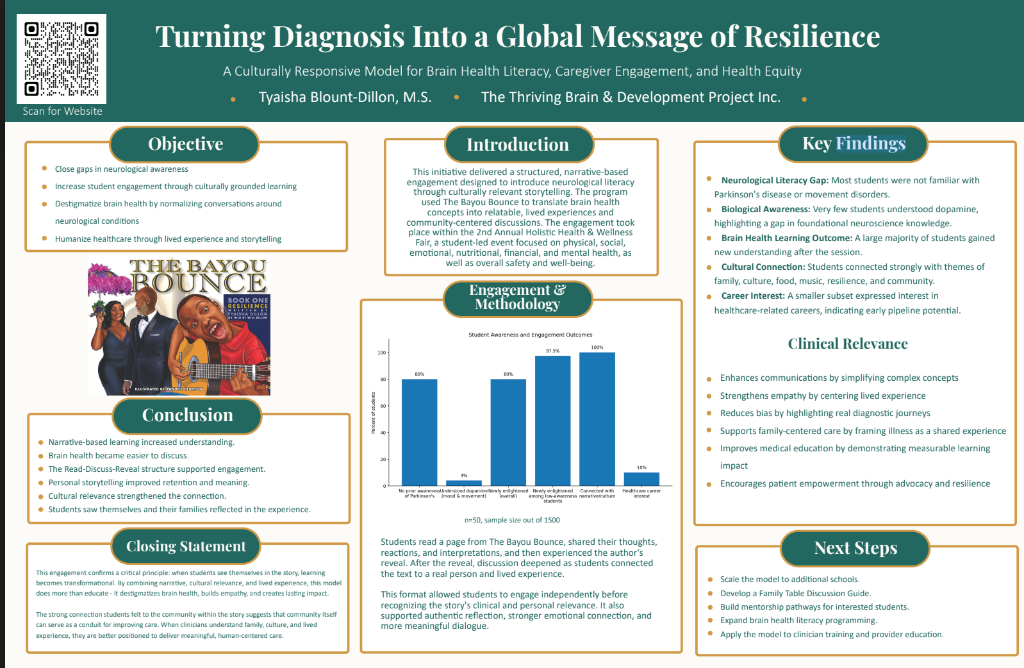
Abstract · Turning Diagnosis Into a Global Message of Resilience · WPC 2026 · Poster ID 726
Student Awareness & Engagement Outcomes · n = 50
No prior Parkinson's awareness
40 of 50 students
Understood dopamine function
2 of 50 students
Newly enlightened via the book
39 of 40 initially unaware
Connected with the narrative
50 of 50 students
Interest in healthcare careers
5 of 50 students
Book Pages Read During the Engagement
Doing the Research
Advocacy
Cooking with Dad
Family
Mom's Dance
Movement
Meet Dad
Lived Experience
Mom's Secret Ingredient for Moving
Resilience
Methodology
Read – Discuss – Reveal
Students read one randomly selected page from The Bayou Bounce.
Students shared thoughts, reactions, and interpretations independently.
Students discovered the author was present — the story was real.
Executive Overview & Event Background
This report presents preliminary findings from a structured brain health engagement conducted during the 2nd Annual Holistic Health & Wellness Fair at Osborne High School in Marietta, Georgia. The fair was designed as an impactful, student-led experience intended to raise health and wellness awareness while equipping students with practical tools for healthier, happier, and more productive lives. Within that broader setting, the engagement used The Bayou Bounce as a culturally grounded, narrative-based learning tool to introduce neurological literacy through storytelling, lived experience, and community-centered discussion.
The event focused on holistic health across physical, social, emotional, nutritional, financial, and mental well-being, as well as overall safety and wellness. Against that backdrop, the Bayou Bounce engagement advanced four strategic objectives: closing gaps in neurological awareness, increasing student engagement through culturally grounded learning, destigmatizing brain health by normalizing conversations around neurological conditions, and humanizing healthcare through lived experience and storytelling.
Educational Context & Site Relevance
The engagement took place at Osborne High School, a public high school in Cobb County serving grades 9 through 12. Publicly available school profile sources characterize Osborne as a large, diverse school community, making culturally responsive, narrative-based brain health education especially relevant in this setting. This context supports the use of family-centered storytelling as an accessible entry point for complex health concepts, particularly in a learning environment where students benefit from content that reflects culture, lived experience, and community.
Methodology & Engagement Framework
The sessions were delivered through a structured small-group model designed for both consistency and depth. A total of 50 students participated, organized into 10 groups of 5 students each. Each session lasted 15 minutes, for a total of 150 minutes of direct engagement.
Each session followed a Read – Discuss – Reveal model: students read one randomly selected page from The Bayou Bounce, discussed their thoughts, reactions, and interpretations, then experienced the Author Reveal — discovering the story was tied to a real author, a real family, and a real health journey. This format allowed students to engage independently before connecting the narrative to lived experience.
Key Findings
The engagement surfaced a clear neurological literacy gap. Most students were not familiar with Parkinson's disease or movement disorders before the session. Foundational biological awareness was also limited, as very few students understood dopamine's role in mood and movement. Even so, the learning outcome was substantial: a large majority appeared to gain new brain health awareness through the book and discussion model.
The cultural dimension of the engagement was especially important. Students connected not simply to information, but to themes of family, culture, food, music, resilience, and community. That broad narrative connection helped make the health content feel relevant rather than distant. A smaller subset also expressed interest in healthcare-related careers, suggesting early pipeline potential.
Qualitative Insights
Students first engaged with the text independently. They shared authentic interpretations, identified personal connections, and reflected on family, resilience, and health before any author context was introduced.
One student related to Will's learning challenges despite not having a formal diagnosis, suggesting that the book created space for recognition and possible support-seeking. Another student living with a neurological condition reported feeling encouraged by the story, demonstrating that the book functioned as both educational and affirming.
The author reveal shifted the experience from academic to deeply personal. Students were visibly surprised when they realized that the author was present and that the story reflected a real life journey. Students also became more open to discussing neurological conditions. Several moved toward seeing patients as whole people rather than diagnoses — a shift one student described as "peeling back the onion."
Analytical Significance
The structured randomization of page selection allowed for a focused thematic exploration. It confirmed that when students are given agency over their learning, they are more likely to connect abstract medical concepts to their own lived realities.
This approach successfully unveiled the emotional layers required to deliver patient care that values the person over the pathology — a concept the students identified as "stellar." Observation of the students' emotional response — finding joy in community and empathy in resilience — suggests that if clinicians adopted this "peeling back the onion" narrative approach, it could fundamentally transform clinical practice by restoring the human element to patient care.
Potential to Enhance Patient Care
Yes. The Bayou Bounce shows clear potential to enhance patient care when used as a narrative-based engagement and education tool. First, it can strengthen health literacy by translating complex neurological concepts into language and experiences that feel accessible to students, families, and community members. Second, it can improve empathy by helping learners and clinicians understand the person behind the diagnosis. Third, it can support family-centered care by framing illness as a shared experience that affects relationships, responsibilities, and daily life.
The model also has practical value for clinician training and provider development. By using storytelling to reduce bias, improve communication, and surface lived experience, the book can help future providers better understand the emotional, cultural, and relational realities of care. In that sense, The Bayou Bounce is not only an educational tool — it is a bridge to more human-centered, empathy-driven, and culturally responsive patient care.
Conclusions
Several conclusions emerge from this engagement. Narrative-based learning increased understanding. Brain health became easier to discuss. The Read – Discuss – Reveal structure supported meaningful engagement. Personal storytelling improved retention. Cultural relevance strengthened connection. Most importantly, students saw themselves and their families in the experience.
Taken together, these outcomes suggest that culturally grounded storytelling can make complex health concepts more accessible, more memorable, and more personally significant while also opening pathways for empathy, reflection, and possible future healthcare interest.
Strategic Next Steps
The most appropriate next steps are to scale the model to additional schools, develop a Family Table Discussion Guide, build mentorship pathways for interested students, expand brain health literacy programming, and adapt the model for clinician training. These next-phase activities would extend the value of the current engagement while positioning the work for broader educational and clinical application.
Future Research Direction
These findings are promising, but they are based on preliminary observational data gathered during a live engagement. A more structured study is needed to assess the impact of The Bayou Bounce on brain health literacy, destigmatization, student self-identification, empathy, and human-centered learning with greater rigor.
A future study could include pre- and post-assessments, standardized content exposure, structured response tools, larger sample sizes, and comparison groups. These additions would support a more rigorous evaluation of changes in awareness, understanding, empathy, and engagement.
§14 · Closing Statement
"When students see themselves in the story, learning becomes transformational."
By combining narrative, cultural relevance, and lived experience, this model does more than educate. It destigmatizes brain health, builds empathy, and creates lasting impact.
The strong student connection to community within the story also suggests that community itself can serve as a pathway to improving care. When clinicians, educators, and families understand culture, relationships, and lived experience, they are better positioned to support people in meaningful, human-centered ways.
Documentation Note: This report is based on preliminary observational notes, the original draft report, the uploaded book file, and subsequent clarifications, including the refined brain health learning metric of 39/40 among students who appeared to begin with limited prior awareness and the documented book pages read during the engagement: 26, 22, 14, 9, 26, and 17.
Ready to partner or scale this model?